
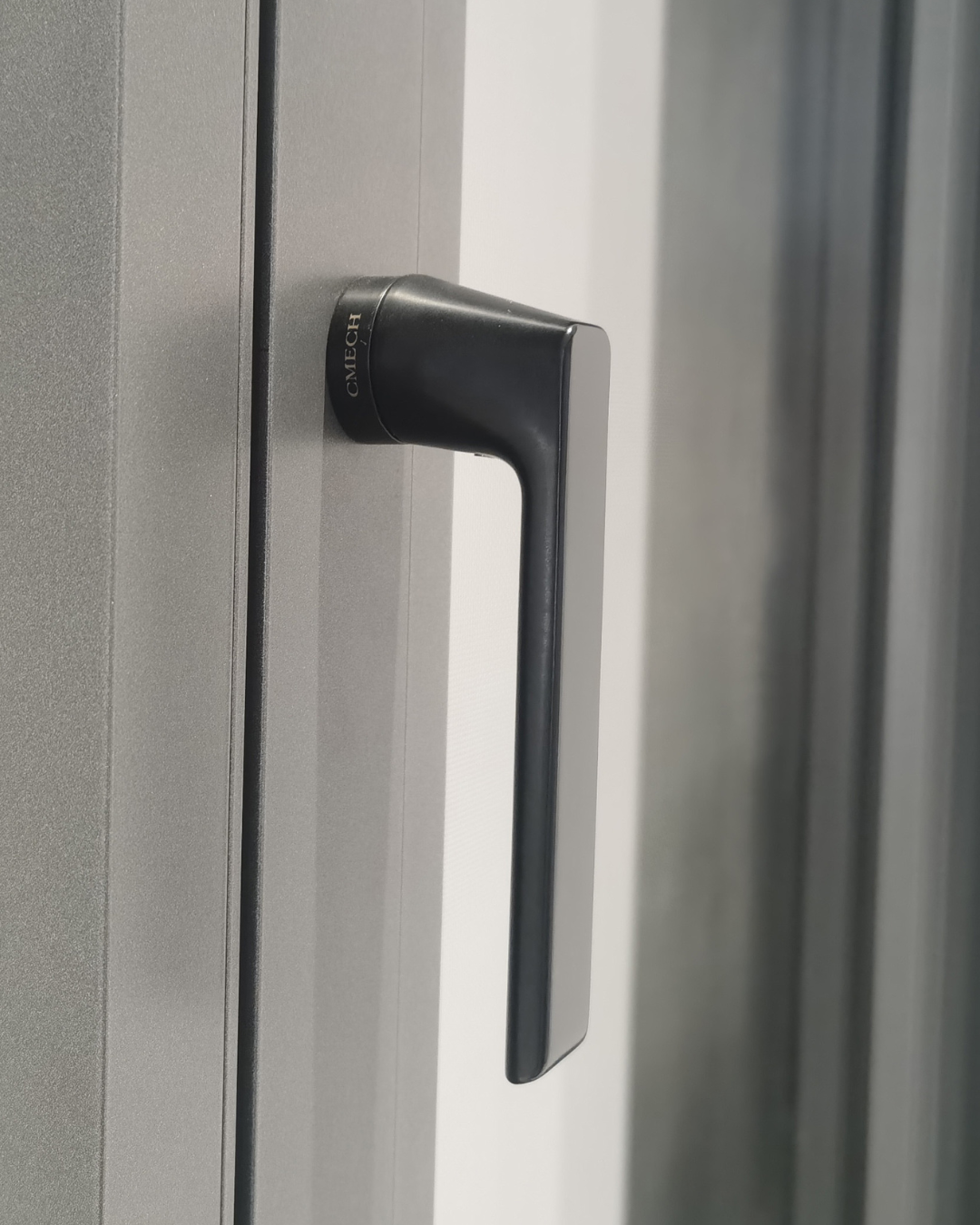
Why hardware selection matters for window performance
Hardware choice changes how a window performs under load, over time and across climates. A robust window handle integrates with sash geometry to control sealing pressure, user torque and long-term wear. In passive-tight assemblies—think Passive House targets at 0.6 ACH50—the incremental leakage saved by a reliable handle and keeper can meaningfully reduce heating/cooling demand. This article applies engineering logic to compare sliding-door-derived pull hardware with purpose-built options for casement and awning units, using measurable metrics rather than marketing claims.
Measurable failure modes and key performance metrics
Evaluate hardware with clear metrics: actuation torque (N·m), seal compression (mm), air leakage (L/s·m²), endurance cycles (cycles to failure) and corrosion resistance (hours in neutral salt spray). A well-designed handle reduces required actuation torque and distributes stress to the sash and frame via the backset and strike plate. Common failure modes include material fatigue at the bearing, latch deformation in the espagnolette linkage, and loss of compression at the sash contact—each detectable through simple bench tests. —Pay attention to lifecycle cycles; field data often shows premature loosening long before visible corrosion.
Comparative analysis: sliding-door hardware adapted for windows
Sliding-door pulls are optimized for linear motion and a different set of loads. When used on casement windows they introduce compromises:
- Load path mismatch: sliding pulls concentrate force near the handle anchor, increasing localized stress on sash corners.
- Seal engagement: sliding hardware rarely provides the multi-point compression an espagnolette does, so airtightness and water resistance suffer.
- Durability: sliding mechanisms use different bearings and guide geometry; those parts wear under rotational loads typical to a crank or lever handle.
By contrast, dedicated casement window handles are engineered for rotational moment transfer, multi-point locking, and controlled compression of the seal. The difference shows up in instrumented tests: lower actuation torque variation, improved repeatable compression, and higher mean cycles to failure.
Practical installation errors and an operational teardown checklist
Field failures usually stem from installation or specification errors rather than intrinsic design flaws. Common mistakes include undersized fasteners, improper backset alignment, and selecting finishes without sufficient salt-spray rating for coastal projects. For a quick operational teardown, follow this checklist: inspect sash-to-frame gap under load, measure torque across multiple points, verify strike plate alignment, check for play in bearings, and run a controlled 10,000-cycle durability test if practicable. {main_keyword} and {variation_keyword} belong in the teardown notes so procurement and engineering track what was tested and why.
Trade-offs: cost, serviceability and retrofit realities
Cost often drives choices toward sliding-door hardware in retrofit projects where the original latch points can’t be reworked. That path lowers immediate material expense but increases long-term service and energy-cost risk. Serviceability must be quantified: mean time to repair (MTTR) and availability of replacement parts are real metrics. For example, a retrofit using an ill-fitting pull may require sash reworking within two years; a purpose-built handle with standardized espagnolette spindles extends in-field service intervals. —Plan for the full-life cost, not just initial procurement.
Golden rules for selecting window hardware (three critical metrics)
1) Prioritize torque stability: choose hardware with less than 10% variation in actuation torque across 1,000 cycles. This predicts consistent sealing and user feel. 2) Demand multi-point compression: ensure the handle links to a locking system that achieves uniform seal compression across the sash (measure in mm). This reduces air leakage and water ingress. 3) Specify corrosion life: require a minimum neutral salt spray rating and define expected hours to failure for coastal or industrial sites; verify vendor data with third-party test reports.
When you combine these metrics, selection becomes a quantifiable process that favors purpose-built solutions for casements and critical ventilators. CMECH has component-level designs and test data that align with these rules—practical value grounded in measured performance. CMECH. —