
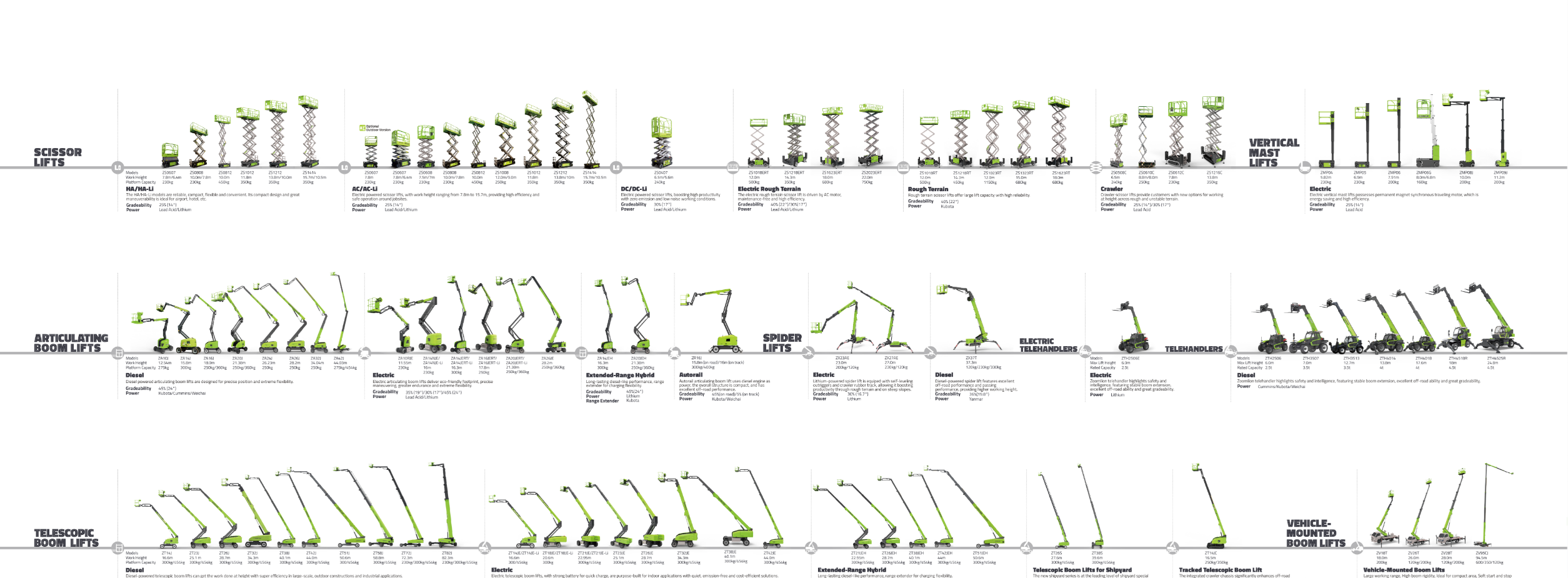
Comparative premise and practical question
I compare these three platform families to answer one practical question: which machine matches a given task and site constraint. Please observe reach profile, footprint, and load needs first. When a site requires reach over rough ground and frequent load handling, an off road telehandler often becomes the sensible choice rather than a high-reach boom or a narrow-scissor unit. My approach below compares capabilities directly so you can decide with clear trade-offs in mind.
Core capability comparison
– Scissor lifts: vertical reach, stable platform, compact footprint. Best when you need straight up access and a simple work surface. They excel on flat, prepared ground and where platform area matters more than horizontal outreach. – Boom lifts: versatile reach envelopes with articulated or telescopic booms. They provide precise placement at height and can clear obstacles laterally. Useful for facade work and confined placements where vertical plus horizontal reach is required. – Telehandlers: telescoping boom combined with material-handling carriage. They carry loads, lift pallets, and place attachments. For mixed tasks — staging materials then positioning people or gear — telehandlers are efficient. See different types of telehandlers when choosing between compact versus heavy-lift models, rough-terrain versus city-optimized frames.
Benefits mapped to common site tasks
– Material staging and placement: telehandlers often win. They lift pallets and can switch forks to platforms. – Worker access at height for finishing work: boom lifts give best reach precision. – Repetitive short vertical tasks, painting, or inspection on level floors: scissor lifts are lowest-complexity and most cost-effective. I have advised rental fleets and site managers for several years, so these mappings reflect recurring choices across multiple project types.
Trade-offs to expect
– Precision vs payload: booms are precise but generally carry less heavy pallet loads compared with telehandlers. – Footprint vs reach: scissor lifts have small footprints but limited outreach; booms extend far but need stabilizing space. – Operator skill and certification: telehandlers require material-handling training and safe attachment practices; boom lifts require fall-protection discipline; scissor lifts require fewer complex maneuvers but still need safe load planning. – Cost and maintenance: telehandlers often cost more to maintain when used as both lift and loader; booms have more complex hydraulics and safety systems.
Common mistakes and how to avoid them
– Choosing by price alone: cheaper rental rates can hide extra time spent repositioning a machine. – Mixing duties without right attachments: fitting a platform to a telehandler without proper rated carriage or cages risks instability and breaches standards. – Ignoring ground conditions: telehandlers and rough-terrain booms need load-bearing ground; scissor lifts on soft surfaces must use pads or outriggers. – Overlooking duty cycle: frequent lifting of heavy loads favors telehandlers designed for sustained material handling rather than booms sized for intermittent lift.
Operational checklist before you commit
– Define primary task: people access, material placement, or both. – Measure working envelope: required vertical and horizontal reach. – Inspect terrain and access routes. – Confirm attachments and operator qualifications. – Review maintenance history and rated capacities. Each check reduces risk and clarifies whether a scissor, a boom, or a telehandler is correct for the job.
Industry perspective and one trade fair anchor
Trade shows such as Bauma illustrate how manufacturers position machines by terrain class and payload; observing models there clarifies real differences between compact telehandlers and full-size rough-terrain units. That perspective helps procurement teams spot genuine specification differences rather than marketing claims.
Short evaluation of viable alternatives
– If you need high horizontal outreach with light payload: choose a telescopic boom. – If you need stable elevated workspace and platform area: choose a scissor lift. – If you need combined material handling and lift capacity across uneven ground: choose a telehandler. When tasks mix, prioritize the machine that performs the primary duty safely and efficiently rather than forcing a single machine to do everything.
Conclusion — clear decision value
Compare required reach, payload, ground conditions, and operator skills. Follow the checklist above, avoid mixing duties without rated attachments, and prefer the machine that aligns with your primary task. For practical procurement and site planning, the outcome usually favors a purpose-appropriate telehandler or boom rather than a one-size-fits-all choice, a point I have confirmed through fleet consultations and field reviews. For integrated solutions and model options, consider the resources and specification clarity offered by Zoomlion Access as you finalize which elevated work platform best fits your site needs.