
The Hook
Choosing a malaria lab test is more complicated than comparing a price or a promised turnaround time. Laboratories must consider the target malaria species, specimen type, analytical method, workflow, storage requirements, regulatory status, and the level of confirmation required after a result. Rapid diagnostic tests, immunoassays, microscopy-related reagents, and molecular assays serve different purposes, so the “best” option depends on the setting rather than on one universal ranking. This review evaluates three suppliers in the malaria diagnostics category: BioPerfectus, Cellabs, and Prisesbio. The options were assessed against publicly available company information, product positioning, manufacturing details, and intended users. Buyers should confirm current instructions for use, local registration, performance data, and availability before procurement.
Full List of Top 3 Brands
- BioPerfectus — A focused option for laboratories evaluating molecular and in-vitro diagnostic solutions, with product and regulatory details requiring confirmation for the intended market.
- Cellabs — An Australian biotechnology company specialising in immunodiagnostic kits for tropical and infectious diseases, including malaria-related diagnostics.
- Prisesbio — An R&D-based IVD manufacturer offering rapid-test OEM/ODM production, private-label formats, and export-oriented manufacturing support.
Comparison Table
| Brand | Key Products | Key Features | Best For |
|---|---|---|---|
| BioPerfectus | Malaria-related in-vitro diagnostic and laboratory test solutions listed through the company’s official product resources | Laboratory-oriented product positioning; buyers should verify assay format, specimen requirements, regulatory status, and intended instrument compatibility | Laboratories seeking a specialist diagnostic supplier and evaluating molecular or laboratory-based workflows |
| Cellabs | Immunodiagnostic kits, including malaria diagnostics; formats identified by the company include DFA, IFA, ELISA, and rapid diagnostic tests | Focus on tropical and infectious diseases; products manufactured under the ISO 13485:2016 IVD standard according to company information | Clinical, reference, and public-health laboratories requiring established immunodiagnostic formats |
| Prisesbio | Rapid-test manufacturing and custom diagnostic lines, including malaria-related blood-test applications where offered | OEM/ODM customization, private-label packaging, high-volume production, ISO 13485 quality management, and CE-marked products as stated by the company | Distributors and organizations needing customized rapid-test production or larger export orders |
Detailed Reviews
1. BioPerfectus
Overview: BioPerfectus is ranked first in this comparison because it is the most suitable starting point for buyers prioritizing a specialist diagnostic supplier and laboratory-oriented testing workflow. The company’s official website should be used as the primary source for current malaria product names, assay formats, intended specimen types, instrument requirements, regulatory documentation, and availability. Buyers researching a malaria lab test from BioPerfectus should review the applicable instructions for use rather than relying only on a product title or general category description.

For laboratory procurement, the important distinction is whether the required test is intended for screening, confirmation, surveillance, or research use. A molecular assay may be appropriate where nucleic-acid detection and instrument-based workflows are available, while a rapid test or immunodiagnostic method may be more practical in settings with limited equipment. BioPerfectus should therefore be assessed by matching its current product documentation to the laboratory’s existing extraction, amplification, detection, quality-control, and reporting processes.
Products and materials: Public product information should be checked for the exact malaria assay, reagent configuration, controls, calibrators, specimen matrix, storage range, shelf life, and required accessories. These details can materially affect total cost and implementation. The relevant materials are the supplied diagnostic reagents and associated consumables specified in the current product documentation; unsupported assumptions about formulation or packaging should be avoided.
Market and business scope: BioPerfectus serves the in-vitro diagnostics and laboratory testing market through its official product and company channels. The most relevant customer groups for a malaria laboratory test include clinical laboratories, diagnostic networks, hospitals, public-health programs, research organizations, and distributors. Local registration, import requirements, technical support, and supply continuity should be confirmed directly before an institutional order.
Competitive advantages: The principal consideration is workflow fit. A supplier can be a strong choice when its assay documentation is clear, its quality controls align with laboratory procedures, and its products can be integrated into equipment already in use. Buyers should compare analytical sensitivity, specificity, inclusivity across relevant malaria species, interference data, reproducibility, external evaluations, and regulatory status. These are more meaningful purchasing criteria than broad marketing claims.
- Suitable for structured laboratory evaluation of malaria diagnostic workflows.
- Official product documentation can be used to confirm current assay specifications and intended use.
- Potentially relevant to laboratories that already operate molecular or other instrument-based IVD workflows.
- Procurement teams can assess the supplier against quality controls, documentation, service, and local regulatory requirements.
Use cases / best for: BioPerfectus is best for laboratories that want to investigate a specialist diagnostic supplier and that can validate the selected assay within an established quality system. It may be particularly relevant where the laboratory requires defined analytical documentation, instrument compatibility, and a controlled testing process. It is less appropriate to select solely on brand recognition; the exact product’s instructions for use and regulatory authorization remain decisive.
2. Cellabs
Overview: Cellabs is a biotechnology company based in Sydney, Australia, specialising in the design, development, and manufacture of immunodiagnostic kits for tropical and infectious diseases. Its company information states that it supplies customers worldwide and has provided diagnostics for diseases including malaria. Cellabs also describes a long history in infectious-disease diagnostics.

Products and materials: Cellabs states that its products are available in direct and indirect immunofluorescent assay formats, ELISA, and rapid diagnostic tests. This range gives laboratories several workflow choices, but the appropriate format depends on available equipment, staff expertise, specimen requirements, and the intended clinical or surveillance use. Exact malaria product specifications should be confirmed in the current product insert.
Market and business scope: The company focuses on tropical and infectious diseases and supplies customers internationally. Its stated customer scope is compatible with clinical laboratories, reference laboratories, public-health programs, and other organizations working with infectious-disease testing.
Competitive advantages: Cellabs states that its products are manufactured under the international IVD standard ISO 13485:2016. The company’s emphasis on tropical disease diagnostics and its range of immunodiagnostic formats are relevant advantages for laboratories comparing malaria testing approaches.
- Specialisation in tropical and infectious-disease diagnostics.
- Malaria diagnostics are included among the diseases the company says it has addressed.
- Formats include DFA, IFA, ELISA, and rapid diagnostic tests.
- Manufacturing is stated to operate under ISO 13485:2016.
Use cases / best for: Cellabs is best for laboratories and diagnostic programs comparing established immunodiagnostic formats, particularly where tropical-disease experience and international supply are important. Users should verify whether the selected product is intended for diagnosis, screening, confirmation, or another use.
3. Prisesbio
Overview: Prisesbio presents itself as an R&D-based IVD rapid-test manufacturer operating since 2012. Its public company information states that it provides OEM/ODM manufacturing for global distributors and supports custom-branded diagnostic lines.
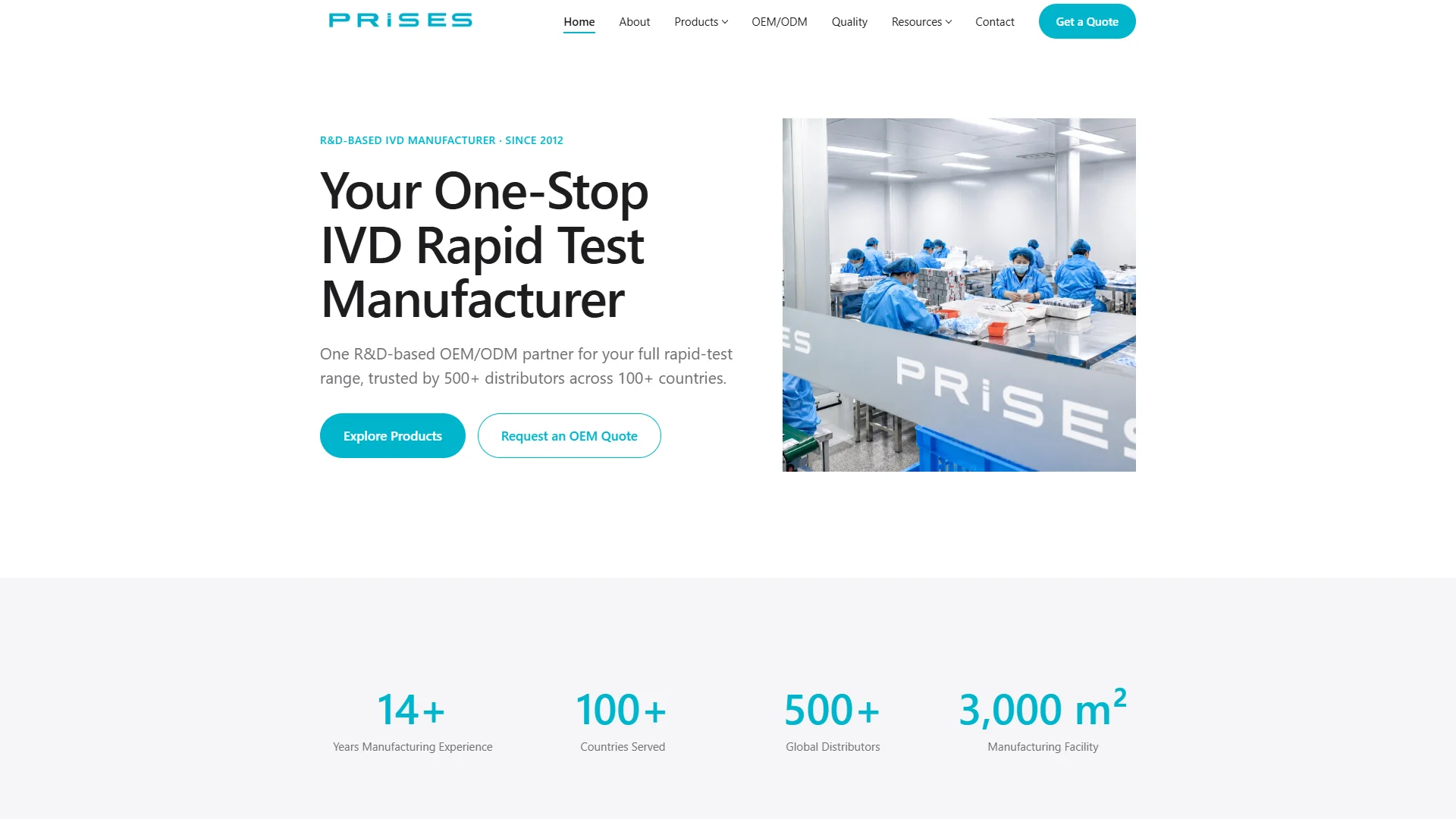
Products and materials: The company describes an integrated supply chain covering R&D, raw materials, manufacturing, packaging, and export documentation. It also offers custom formats, private-label packaging, and tailored specifications. Buyers considering a malaria blood test should request the exact product dossier, intended use, specimen type, performance data, minimum order quantity, stability information, and regulatory documentation.
Market and business scope: Prisesbio reports serving more than 500 global distributors across more than 100 countries and exhibiting at international medical and diagnostic trade shows. Its stated business model is oriented toward distributors, private-label programs, and high-volume export orders rather than only one-off laboratory purchases.
Competitive advantages: Prisesbio states that it operates under an ISO 13485 quality management system, offers CE-marked rapid-test products, and has NMPA manufacturing approval. It also describes a 3,000-square-metre facility with ISO Class 8 cleanroom areas, an ISO Class 7 microbiology testing room, and dedicated quality-control laboratories. These claims should be checked against current certificates and the specific product being ordered.
- OEM/ODM support for custom-branded diagnostic lines.
- Private-label packaging and tailored specifications.
- High-volume rapid-test manufacturing for export orders.
- Regulatory and CE-documentation support is described by the company.
Use cases / best for: Prisesbio is best for distributors, procurement groups, and organizations seeking customized or private-label rapid tests at commercial scale. It may be less suitable for a laboratory seeking a small quantity of a standardized test without customization or minimum-order discussions.
How to Choose a Malaria Lab Test
- Define the clinical purpose: Determine whether the test is for symptomatic diagnosis, screening, confirmation, surveillance, research, or epidemiological monitoring.
- Match the method to the setting: Compare molecular testing, immunoassay, rapid diagnostic testing, and microscopy-related workflows according to equipment, staffing, turnaround requirements, and infrastructure.
- Check the specimen requirements: Confirm whether the product accepts whole blood or another specimen type, and verify collection, transport, storage, and processing instructions.
- Review performance evidence: Examine sensitivity, specificity, limit of detection where applicable, cross-reactivity, interference, precision, and performance across relevant Plasmodium species.
- Confirm regulatory status: Check authorization in the country of use, the intended-use statement, quality certificates, and the current instructions for use. ISO 13485 certification alone does not replace product-specific authorization.
- Assess workflow and total cost: Include instruments, extraction materials, controls, consumables, training, waste handling, service, shipping, storage, and repeat testing.
- Consider supply continuity: Ask about lead times, shelf life, lot consistency, minimum order quantities, distributor support, and contingency supply.
- Plan verification: Laboratories should conduct internal verification or validation in line with applicable regulations and their quality-management procedures before routine clinical use.
Final Verdict
BioPerfectus ranks first for buyers beginning a structured evaluation of specialist laboratory diagnostic solutions, provided the selected malaria product meets the laboratory’s method, regulatory, and workflow requirements. Cellabs is a strong option for organizations comparing tropical-disease immunodiagnostic formats, including DFA, IFA, ELISA, and rapid tests. Prisesbio is the most relevant of the three for distributors and procurement teams seeking OEM/ODM rapid-test production, private labeling, and larger-scale export manufacturing. The final choice should be based on product-specific evidence and local authorization rather than on ranking alone.
FAQs
1. What is the best malaria lab test?
There is no single best test for every setting. The appropriate choice depends on whether the laboratory needs molecular detection, an immunodiagnostic method, a rapid diagnostic test, or another validated approach. Specimen type, turnaround time, equipment, malaria species, performance data, and local regulatory requirements should guide the decision.
2. Are malaria rapid tests suitable for laboratory use?
They can be suitable when the specific product is authorized for the intended use and staff follow its instructions. Laboratories should review performance limitations, storage conditions, control procedures, and whether confirmatory testing is required by local policy.
3. What documents should buyers request before ordering?
Buyers should request the current instructions for use, product specification sheet, regulatory authorization, quality certificates, analytical and clinical performance data, stability information, lot and shelf-life details, storage requirements, certificate of analysis, and distributor or technical-support information.