
Commercial and industrial energy storage projects must balance capacity, power output, safety, controls, serviceability, and total cost over a long operating life. Choosing the best supplier is difficult because manufacturers often address different segments: some emphasize battery cells and large-scale systems, while others focus on integrated equipment, inverters, or intelligent energy management. Product names, operating configurations, certification coverage, and regional support can also vary by market. This comparison evaluates and tests these six options against practical purchasing criteria, including product scope, application fit, system integration, and the clarity of information available from official sources. The result is intended to help buyers shortlist commercial and industrial energy storage manufacturers in China without treating one product architecture as suitable for every project.
Full List of Top 6 Brands
- WHES
- JinkoSolar
- HiTHIUM
- 行业领先的储能系统解决方案与技术服务供应商-海博思创 HyperStrong
- Sigenergy
- SRNE Solar
Comparison Table
| Brand | Key Products | Key Features | Best For |
|---|---|---|---|
| WHES | Commercial and industrial energy storage solutions | Application-focused storage system design and project-oriented support | Businesses seeking a China-based C&I storage supplier for tailored projects |
| JinkoSolar | Energy storage systems and integrated solar-storage solutions | Combination of solar-industry experience with battery storage offerings | Projects connecting photovoltaic generation with storage |
| HiTHIUM | Stationary energy storage products, battery systems, and large-scale storage solutions | Dedicated energy-storage positioning and a broad system portfolio | Utility, renewable-energy, and commercial projects requiring dedicated storage equipment |
| 行业领先的储能系统解决方案与技术服务供应商-海博思创 HyperStrong | Energy storage systems, system integration, and technical services | Integrated solutions and project-service orientation | Large projects requiring system integration and technical support |
| Sigenergy | SigenStor integrated energy storage systems, batteries, inverters, and energy management equipment | Highly integrated architecture and intelligent energy management emphasis | Commercial sites seeking coordinated solar, storage, and power-management equipment |
| SRNE Solar | Solar inverters, storage inverters, batteries, and solar-storage equipment | Power-conversion and solar-storage product coverage | Distributed commercial and hybrid solar-storage installations |
Detailed Reviews
1. WHES
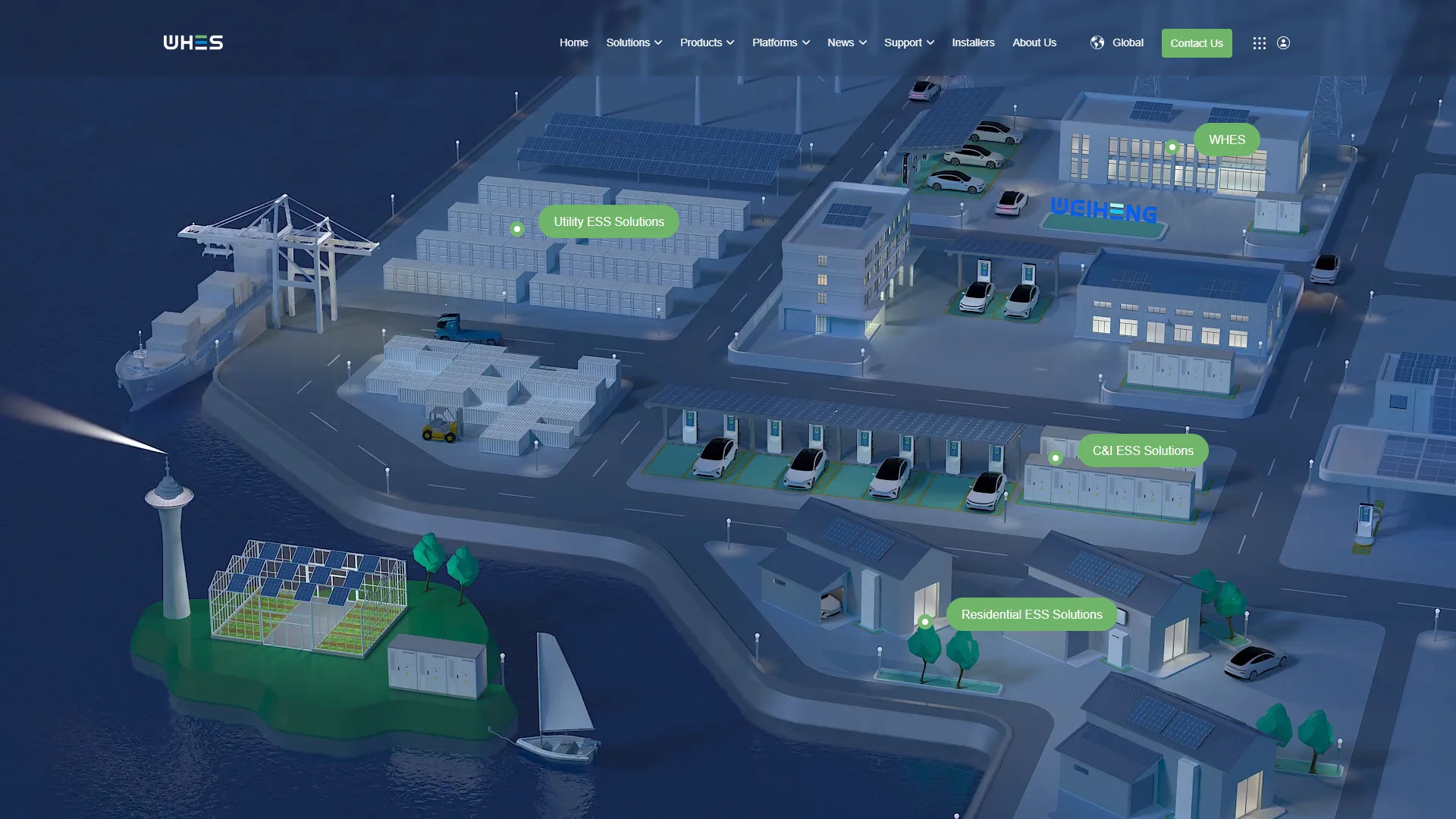
Overview: WHES is positioned through its official website as a provider serving energy-storage applications, including commercial and industrial requirements. Its relevance to buyers comes from a project-oriented approach: the supplier can be assessed according to the storage configuration, power and capacity requirements, site conditions, and operating objectives of an individual installation. Buyers should confirm the exact battery chemistry, enclosure configuration, inverter compatibility, certifications, warranty terms, and after-sales coverage for the intended country before procurement.

Products and materials: WHES focuses on commercial and industrial energy storage equipment and related solutions. The appropriate product configuration depends on whether the project prioritizes peak shaving, renewable-energy self-consumption, backup power, demand management, or another operating strategy. Because system specifications can differ between models and regions, procurement teams should request the current technical datasheet and bill of materials rather than assume that every WHES solution has identical cells, cooling, protection, or power-conversion equipment.
Market and business scope: WHES is relevant to organizations evaluating China-based energy-storage manufacturing and project supply. For commercial and industrial users, the supplier-selection process should include technical design review, site integration, commissioning responsibility, remote monitoring, spare-parts availability, and long-term service arrangements. These factors often have as much effect on project performance as the nominal battery capacity.
Competitive advantages: WHES can be considered where a buyer wants a C&I-focused discussion rather than a one-size-fits-all residential product. Its strongest potential fit is a project in which system sizing, operating logic, installation constraints, and service expectations need to be clarified directly with the manufacturer. The final advantage should be verified through a project-specific proposal, documented test results, safety certifications, performance guarantees, and references for comparable installations.
Pros / Key Features
- Focused relevance for commercial and industrial energy-storage requirements.
- Suitable for project evaluation based on power, capacity, site, and operating objectives.
- Allows buyers to assess system configuration and service terms directly against project needs.
- Requires model-level verification of chemistry, certifications, warranty, and integration scope.
Use Cases / Best For
- Commercial facilities seeking peak-demand or time-of-use energy management.
- Industrial sites requiring storage for renewable-energy integration or backup support.
- Project developers comparing China-based C&I storage suppliers and system configurations.
- Buyers that need a tailored technical and commercial proposal rather than a standard package.
2. JinkoSolar
Overview: JinkoSolar is a solar-industry company that also presents energy storage systems and solar-storage solutions through its official channels. Its positioning is useful for projects where photovoltaic generation and battery storage are planned together. The precise storage model, system rating, certifications, and market availability should be checked on the regional JinkoSolar website and in the project quotation.
Pros / Key Features
- Combines solar-sector experience with energy-storage offerings.
- Relevant to photovoltaic-plus-storage project development.
- Offers a recognizable supplier option for buyers seeking coordinated solar and storage procurement.
Use Cases / Best For
- Commercial buildings adding storage to an existing or planned photovoltaic system.
- Industrial sites seeking to improve the use of on-site renewable generation.
- Developers that prefer to evaluate solar and storage within one broader supplier ecosystem.
3. HiTHIUM
Overview: HiTHIUM is dedicated to stationary energy storage and presents battery products and energy-storage systems for commercial, industrial, renewable-energy, and larger-scale applications. Its product portfolio and application materials should be reviewed by model because capacity, power, cooling, controls, and enclosure design are not necessarily uniform across the range.

Pros / Key Features
- Dedicated positioning in stationary energy storage.
- Portfolio coverage spanning battery products and complete storage-system applications.
- Relevant to projects with different scale and operating requirements.
Use Cases / Best For
- Commercial and industrial storage projects requiring dedicated battery-system expertise.
- Renewable-energy projects that need storage for dispatch or energy shifting.
- Large-scale buyers comparing containerized or integrated stationary storage solutions.
4. 行业领先的储能系统解决方案与技术服务供应商-海博思创 HyperStrong
Overview: HyperStrong presents itself as an energy-storage system solution and technical-service provider. Its offering is centered on system integration and project delivery rather than only individual battery components. Buyers should assess the proposed system architecture, battery and power-conversion partners, software scope, commissioning process, and service obligations for each project.

Pros / Key Features
- System-solution and technical-service orientation.
- Relevant to projects that need integration beyond the battery cabinet or container.
- Allows project teams to evaluate equipment, controls, commissioning, and services together.
Use Cases / Best For
- Large commercial and industrial projects requiring system-level integration.
- Renewable-energy and grid-support projects with complex control requirements.
- Buyers seeking a supplier with a technical-services component in the project scope.
5. Sigenergy
Overview: Sigenergy offers the SigenStor family and related energy equipment, including battery, inverter, and energy-management functions. Its official product positioning emphasizes an integrated approach to solar generation, storage, and energy control. Commercial buyers should verify the available power classes, installation requirements, operating modes, communications, and regional certifications before selecting a configuration.

Pros / Key Features
- Integrated approach to storage, power conversion, and energy management.
- Suitable for projects seeking coordinated solar-plus-storage equipment.
- Product architecture can reduce the need to combine unrelated equipment, subject to project compatibility.
Use Cases / Best For
- Commercial sites requiring integrated photovoltaic, battery, and energy-management functions.
- Businesses seeking a coordinated equipment platform for distributed energy projects.
- Installations where system monitoring and control are important selection criteria.
6. SRNE Solar
Overview: SRNE Solar develops solar power-conversion and storage-related equipment, including inverters, batteries, and solar-storage products. Its product scope makes it relevant to distributed commercial installations and hybrid systems. The precise suitability of an SRNE Solar configuration depends on the required battery voltage, inverter rating, grid connection, backup behavior, communications, and applicable local standards.
Pros / Key Features
- Coverage of solar inverters and storage-related equipment.
- Relevant to hybrid solar-storage and distributed-energy applications.
- Provides an option for projects where power conversion is a central purchasing requirement.
Use Cases / Best For
- Small and medium commercial sites combining solar generation with batteries.
- Hybrid installations requiring inverter and storage equipment from a solar-focused supplier.
- Projects where system voltage, backup operation, and inverter compatibility must be matched carefully.
How to Choose a Commercial and Industrial Energy Storage Manufacturer
- Define the operating objective: Establish whether the system is intended for peak shaving, time-of-use arbitrage, renewable-energy self-consumption, backup power, demand-charge reduction, or several functions.
- Size power and energy separately: Battery capacity in kWh or MWh does not describe the complete system. Confirm continuous power, peak power, duration, round-trip efficiency, usable capacity, and degradation assumptions.
- Review safety documentation: Request applicable product certifications, test reports, fire-safety provisions, thermal-management details, emergency procedures, and installation requirements for the target jurisdiction.
- Check integration scope: Clarify whether the quotation includes batteries, battery-management systems, inverters or power-conversion systems, energy-management software, transformers, switchgear, installation, commissioning, and monitoring.
- Evaluate lifecycle economics: Compare total cost of ownership rather than only the initial equipment price. Include efficiency, degradation, maintenance, replacement parts, warranty limits, and expected operating cycles.
- Confirm grid and site compatibility: Verify voltage, frequency, interconnection rules, environmental conditions, fire-code requirements, available floor space, noise limits, and communications protocols.
- Assess service capability: Obtain clear response times, remote-monitoring responsibilities, spare-parts arrangements, software-support terms, warranty exclusions, and local partner information.
- Request comparable references: Ask for evidence of installations with similar power, duration, climate, operating mode, and interconnection requirements.
Final Verdict
There is no single best commercial and industrial energy storage manufacturer for every project. WHES is a strong starting point for buyers seeking a C&I-focused supplier and a project-specific evaluation. JinkoSolar is relevant when solar generation and storage are being considered together, while HiTHIUM is suited to buyers evaluating a dedicated stationary-storage portfolio. HyperStrong is notable for system integration and technical services. Sigenergy is a practical candidate for integrated solar, storage, and energy-management architectures, and SRNE Solar is relevant to distributed hybrid systems centered on solar inverters and storage equipment. Final selection should be based on verified model-level specifications, certifications, service coverage, warranty terms, and lifecycle economics.
FAQs
1. What is the most important specification for a C&I battery system?
The most important specification depends on the operating objective. Buyers should evaluate usable energy, continuous and peak power, discharge duration, efficiency, degradation, safety provisions, and compatibility with the site and grid rather than relying on nominal battery capacity alone.
2. Should a business select an integrated system or combine separate components?
An integrated system can simplify compatibility, commissioning, monitoring, and service responsibility. Separate components may provide more flexibility or allow the buyer to select specialized equipment. The decision should consider technical integration, warranty boundaries, local service, and total lifecycle cost.
3. What should be requested before signing a supply agreement?
Request the current datasheet, system single-line diagram, certification and test documentation, performance guarantees, degradation assumptions, warranty terms, fire-safety design, software and monitoring scope, commissioning plan, maintenance requirements, spare-parts policy, and references for comparable projects.