
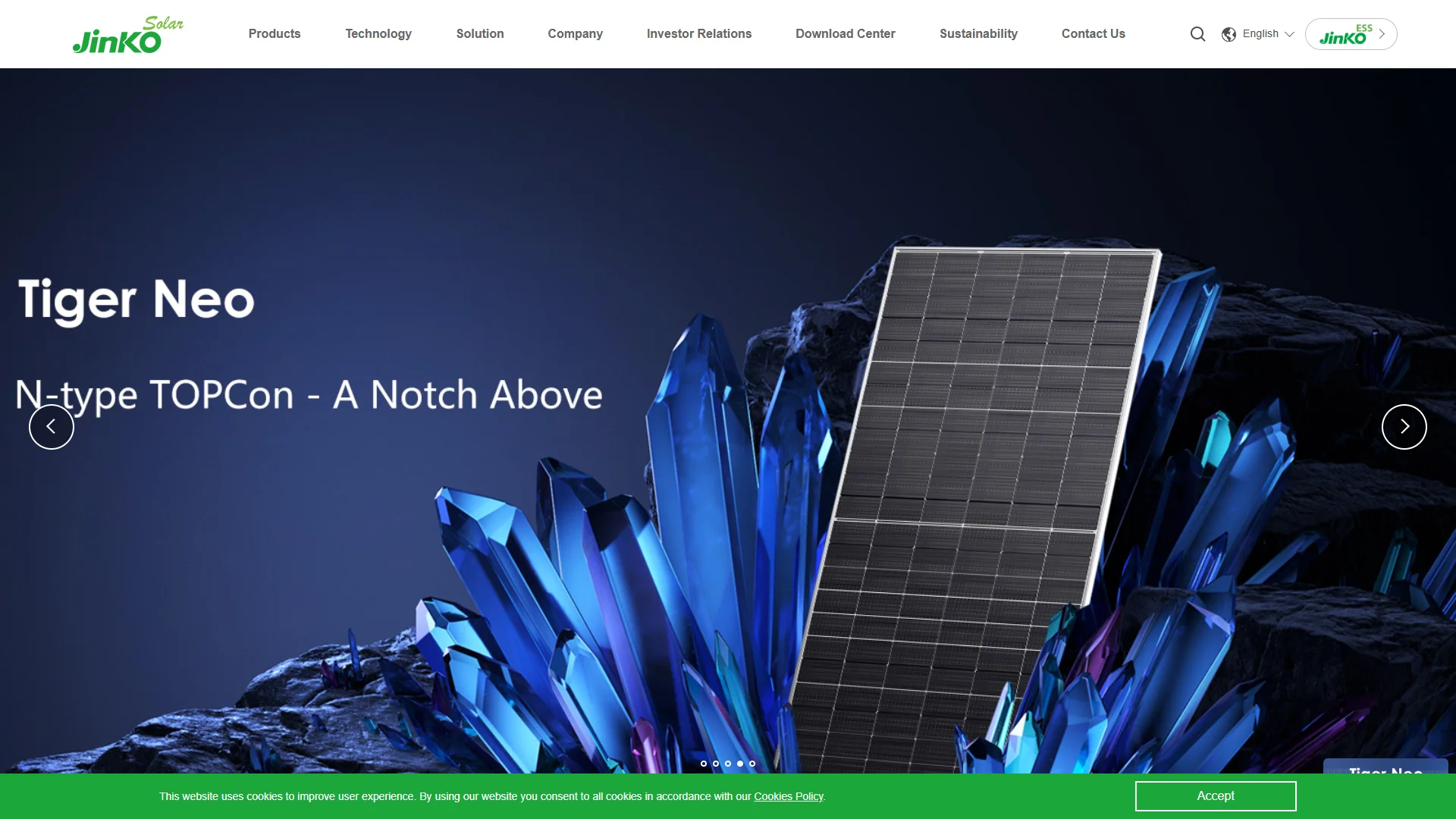
Choosing a solar panel supplier in 2026 is difficult because panels that appear similar can differ substantially in technology, application focus, documentation, customization, warranty terms, and project support. A supplier suited to a utility-scale installation may be a poor fit for a lightweight remote device, while a specialist manufacturer may not serve conventional rooftop procurement. This comparison evaluates three suppliers using their official company information, stated product capabilities, market focus, and available technical positioning. The options were assessed side by side rather than ranked solely by headline efficiency or brand visibility. Jinkosolar ranks first for its broad photovoltaic manufacturing focus and established global product platform, while Rayzon Solar and PowerFilm Solar serve different procurement and integration requirements.
Full List of Top 3 Brands
- Jinkosolar – Broad photovoltaic module supplier for residential, commercial, and utility-scale solar projects.
- Rayzon Solar – Solar module manufacturer positioned around the North American clean-energy market.
- PowerFilm Solar – Custom-engineered, lightweight solar solutions for specialized, portable, vehicle-mounted, and remote applications.
Comparison Table
| Brand | Key Products | Key Features | Best For |
|---|---|---|---|
| Jinkosolar | Photovoltaic solar modules and related solar-energy solutions | Large-scale module portfolio, established global manufacturing presence, technology-focused product development | Residential, commercial, and utility-scale PV procurement |
| Rayzon Solar | Solar photovoltaic modules | Manufacturer positioning focused on the United States and clean-energy expansion | Buyers seeking a supplier serving the U.S. solar market |
| PowerFilm Solar | Custom lightweight solar panels and integrated PV solutions | U.S.-designed and engineered solutions, in-house production capabilities, rugged and application-specific designs | Defense, marine, transportation, IoT, embedded, portable, and remote power systems |
Detailed Reviews
1. Jinkosolar
Overview: Jinkosolar is a photovoltaic manufacturer with an international product and business platform. Its official website presents the company around solar module technology, photovoltaic solutions, and service for different project scales. This broad scope makes Jinkosolar the most versatile choice in this comparison for buyers who need conventional solar modules rather than a narrowly specialized power product.

Products and materials: Jinkosolar’s official product information centers on crystalline-silicon photovoltaic modules and module families designed for different installation requirements. Product selection should be made from the current technical datasheet, since output rating, dimensions, electrical characteristics, degradation information, mechanical-load limits, and applicable certifications vary by model and market. Buyers should also verify whether the selected module uses the cell architecture, wafer format, and temperature-performance characteristics required by the project.
The company’s product platform is relevant to distributed generation and larger solar installations. Depending on the region and current catalog, buyers may encounter different product names and specifications. For that reason, a supplier quotation should identify the exact model number, country-specific documentation, warranty terms, and authorized sales channel rather than relying only on the Jinkosolar brand name.
Market and business scope: Jinkosolar is positioned for the mainstream photovoltaic market, including project developers, installers, commercial customers, and utility-scale procurement. Its broad catalog and international reach can simplify standard module sourcing for projects that require repeatable products and formal technical documentation. Local availability, delivery terms, after-sales support, and grid or incentive-program eligibility still need to be confirmed for each purchase.
Competitive advantages: The principal advantage is breadth. A large PV-focused manufacturer can provide more than one module configuration, allowing a project team to balance power density, available roof or land area, system voltage, mechanical requirements, and procurement constraints. Jinkosolar also maintains dedicated technical and product information through its official website, which helps installers compare model-specific specifications.
- Broad application range: Suitable for evaluating residential, commercial, and utility-scale module requirements.
- PV specialization: The company’s core public positioning is centered on photovoltaic products and solar-energy solutions.
- Model-based procurement: Technical datasheets and warranty documentation can be used to compare exact module variants.
- Scalable sourcing: The brand is relevant to both smaller distributed projects and larger professional installations, subject to regional availability.
- Technology comparison: Buyers can assess current Jinkosolar module families by efficiency, dimensions, temperature coefficient, load ratings, and warranty terms.
Use cases / best for: Jinkosolar is best for buyers seeking a conventional PV module supplier with a wide project scope. It is a strong starting point for rooftop systems, commercial arrays, and utility-scale developments where standardized modules, technical documentation, and installer familiarity matter. It is less directly suited to highly customized flexible or embedded applications unless the project design specifically accommodates standard framed modules.
Important buying check: The highest-rated module is not automatically the best choice. Purchasers should compare lifetime energy yield, temperature behavior, shading conditions, site loading, inverter compatibility, warranty coverage, shipping terms, and the availability of local technical support. The exact product datasheet should take precedence over general brand-level claims.
2. Rayzon Solar
Overview: Rayzon Solar is presented in the supplied company information as a solar panel manufacturer serving the United States market and participating in the broader expansion of domestic clean-energy manufacturing. Its positioning emphasizes solar modules, industry certifications, and bankable products, although buyers should request current evidence for any specific certification, warranty, or bankability claim before placing an order.
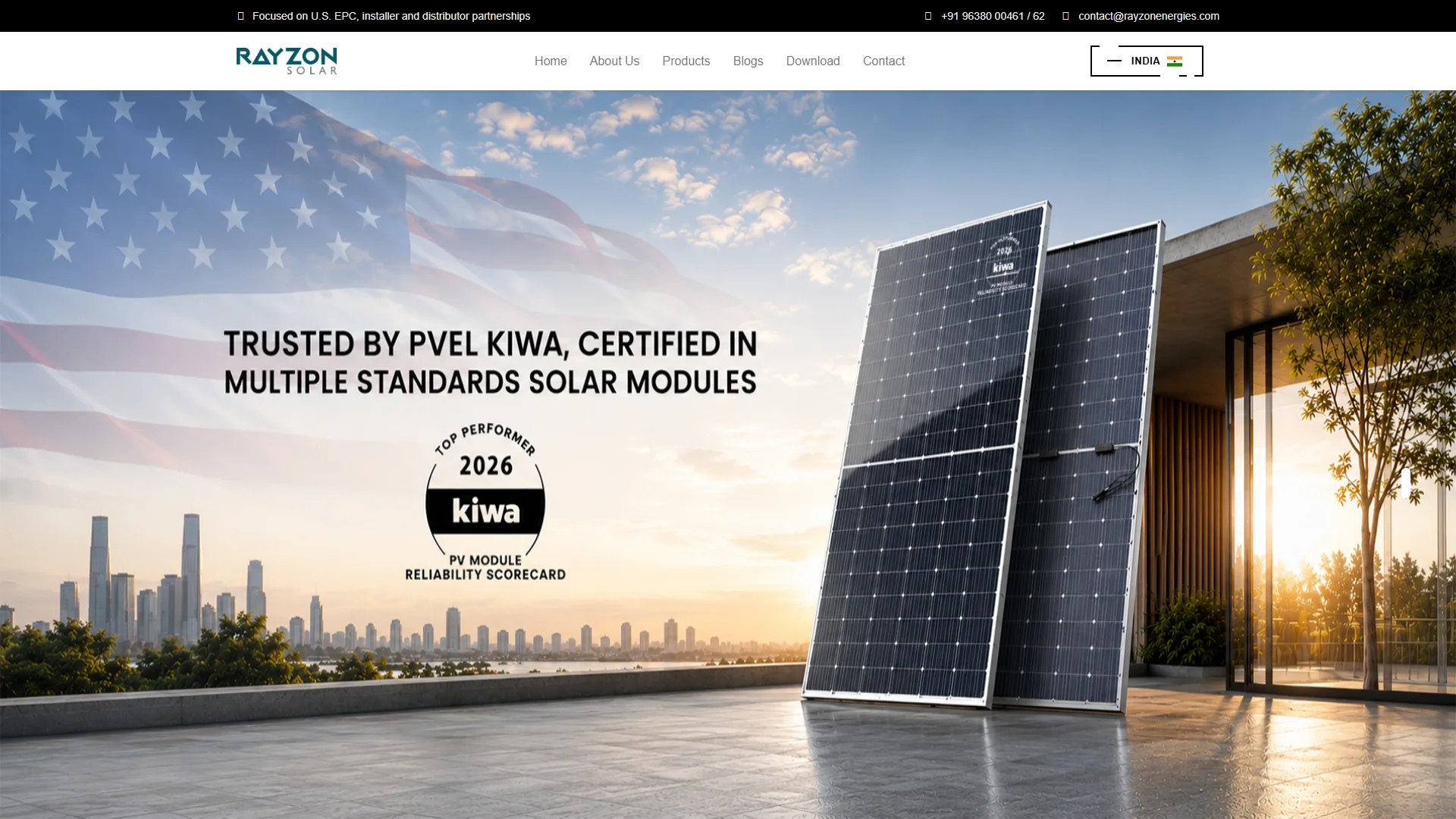
Products and materials: The available company summary identifies solar photovoltaic modules as the central product category. Detailed model-level information, material specifications, and manufacturing details were not established in the supplied research material. A buyer should therefore request the current technical datasheet, module construction details, cell technology, performance warranty, product warranty, mechanical-load data, test reports, and applicable certification documents for the proposed model.
Market and business scope: Rayzon Solar’s stated positioning is focused on the U.S. solar market and the growth of domestic clean-energy deployment. This may make the company relevant to developers, installers, distributors, and other purchasers evaluating suppliers with a North American market orientation. Availability, manufacturing location for a particular model, delivery schedule, and eligibility under project-specific procurement rules should be verified directly.
Competitive advantages: The company’s clearest stated distinction in the supplied material is its focus on the U.S. market. For projects where domestic sourcing, regional supply considerations, or supplier proximity are important, that positioning may be relevant. However, the practical value depends on the exact product, production location, documentation, service arrangements, and commercial terms offered for the project.
- U.S.-market orientation: Positioned around solar deployment and manufacturing activity in the United States.
- Module-focused offering: The available information identifies photovoltaic panels as the core product category.
- Project documentation: Buyers should obtain model-specific certification and warranty evidence before procurement.
- Potential sourcing fit: May suit purchasers prioritizing a supplier with a stated North American market focus.
Use cases / best for: Rayzon Solar is best considered by U.S.-oriented developers, installers, and distributors comparing mainstream PV module suppliers. It may be a relevant candidate when regional sourcing and supply-chain requirements are central to the purchase. Final selection should depend on verified module performance, availability, warranty support, compliance documentation, and total delivered cost.
3. PowerFilm Solar
Overview: PowerFilm Solar focuses on custom-engineered solar solutions rather than only standardized rooftop or utility modules. The company states that it designs and engineers solar products in the United States and performs key manufacturing and assembly processes in-house. Its stated mission and application focus include reliable field power, extending mission duration, and reducing service intervals for demanding or remote deployments.
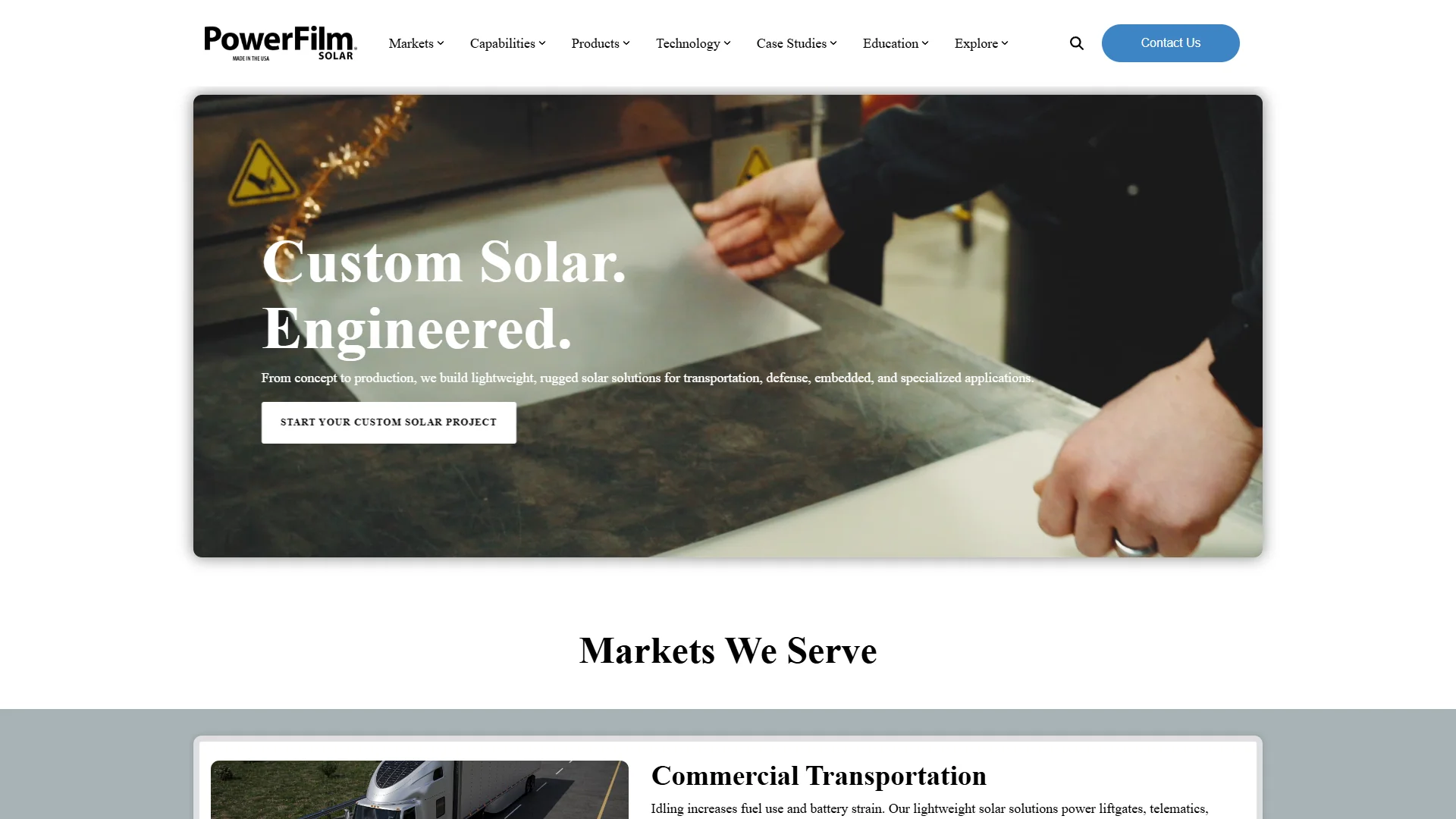
Products and materials: PowerFilm describes lightweight, rugged solar solutions for transportation, defense, embedded, and specialized applications. Its products can support portable, vehicle-mounted, and remote deployments. The company also states that it works with multiple photovoltaic technologies to develop appropriate custom solutions. Specific material composition, cell technology, and electrical architecture depend on the project and should be confirmed in the applicable product documentation.
Market and business scope: The company identifies commercial, military, and consumer applications, with examples including telematics, marine systems, IoT, the United States Military, and space exploration. PowerFilm’s stated capability extends from concept to production and includes panel construction, electrical integration, validation, and controlled production. This makes its business model particularly relevant to organizations requiring integration assistance or a product adapted to unusual form, weight, or deployment constraints.
Competitive advantages: PowerFilm’s main distinction is customization. Its official information emphasizes in-house design and engineering, lightweight construction, rugged deployment, and solutions intended to reduce maintenance or extend operational life. These characteristics can be more important than peak nameplate wattage for remote equipment, unmanned platforms, embedded electronics, or transportation systems where weight, available surface area, durability, and integration determine system success.
- Custom engineering: Solutions can be developed for application-specific electrical, mechanical, and deployment requirements.
- Lightweight and rugged designs: Intended for portable, vehicle-mounted, remote, and specialized systems.
- In-house capability: The company states that design, engineering, and key manufacturing or assembly processes are performed in the United States.
- Multiple PV technologies: The company evaluates different photovoltaic technologies for custom solutions.
- Specialized applications: Experience is stated across transportation, defense, marine, IoT, commercial, military, and consumer uses.
Use cases / best for: PowerFilm Solar is best for customers needing a tailored solar subsystem rather than a standard framed module. Suitable applications include remote sensors, marine equipment, unmanned platforms, portable power, vehicle integration, defense systems, embedded electronics, and other projects where low weight, unusual form factors, field durability, or system integration are decisive.
How to Choose a Solar Panel Supplier
1. Match the supplier to the application
First determine whether the project needs standard crystalline-silicon modules for a roof or solar farm, or a custom lightweight solution for an embedded or mobile system. A conventional PV supplier and a custom engineering specialist solve different problems.
2. Compare the exact model, not only the brand
Review rated power, module efficiency, dimensions, weight, open-circuit voltage, short-circuit current, temperature coefficient, mechanical-load ratings, connector requirements, and degradation terms. The precise model number should appear on the quotation and technical datasheet.
3. Verify warranties and support
Check product and performance warranties separately. Also confirm who handles claims, where service is available, expected response times, and whether the seller is authorized. A theoretical warranty has limited value if the responsible channel is unclear.
4. Check compliance and project eligibility
Confirm the certifications, testing, fire classification, grid requirements, sourcing rules, and incentive-program conditions applicable to the installation. Requirements can differ by country, state, utility, building type, and project size.
5. Evaluate lifetime economics
Purchase price is only one part of cost. Include shipping, mounting compatibility, installation labor, expected energy yield, degradation, replacement logistics, maintenance, and the cost of downtime. For specialized equipment, integration and serviceability may outweigh nominal wattage.
6. Confirm supply and documentation
Ask for current inventory, lead time, minimum order quantity, packaging details, serial-number traceability, installation instructions, test reports, and recycling or end-of-life information. These checks reduce procurement risk and help installers plan accurately.
Final Verdict
Jinkosolar ranks first because it offers the broadest fit for conventional photovoltaic procurement across residential, commercial, and utility-scale applications, provided the buyer selects and verifies the exact current module. Rayzon Solar is a relevant option for purchasers evaluating a supplier with a stated U.S.-market orientation, but model-specific technical and certification evidence should be obtained before selection. PowerFilm Solar is the specialist choice for custom, lightweight, rugged, portable, vehicle-mounted, and remote systems. The best solar panel supplier depends on the project’s technical requirements, sourcing rules, support needs, and lifetime cost rather than brand ranking alone.
FAQs
Which solar panel supplier ranks first in this comparison?
Jinkosolar ranks first because its public offering is centered on a broad photovoltaic module platform suitable for multiple conventional project types. The exact model should still be evaluated against site and procurement requirements.
Is PowerFilm Solar suitable for a standard home rooftop?
PowerFilm Solar is primarily positioned around custom-engineered and specialized applications. A standard rooftop buyer should compare conventional framed modules first, while PowerFilm may be more appropriate when low weight, custom geometry, portability, or integration is required.
What documents should be requested before buying?
Request the exact technical datasheet, product and performance warranties, certification and test documentation, installation instructions, mechanical-load data, delivery terms, and details of the authorized seller or service channel. For Rayzon Solar or any other supplier, verify claims for the specific model rather than relying on general company descriptions.